 zurück


Terminology
The term “display” can be understood in very different ways. Here, a “display” is the central component for displaying an image consisting of individual “pixels” (without the necessary external circuitry). These are usually so-called “LCD” displays (LCD = “Liquid Crystal Display”), in which the individual pixels contain liquid crystals. By applying a voltage to a pixel, its liquid crystals modulate the transmittance of the backside illumination. There are also other designs, such as OLED displays made from organic light-emitting diodes, whereby each design has advantages and disadvantages compared to the more common LCDs.
In order for an image to appear on the display, further circuits and signals are required, including the so-called “backlight” for illuminating the liquid crystals in the pixels from behind, different auxiliary voltages for handling the individual pixels, and of course the data signals, which contain the information about the image to be displayed.
Combined with the necessary additional electronics but without the production of the signals for the image itself, the “display” becomes a “screen”, which can then be connected to, say, a data source. For example, if you combine such a screen with a receiver, you get a television.
For many industrial applications, it is not only necessary to display images from an external source, but also to display operational controls required by the application.
Our products include the ability to show such control elements on the display and also to evaluate an operator’s interaction with the controls in order to be able to react accordingly. We call these assemblies “LCM modules”, the ‘M’ stands for “module”.
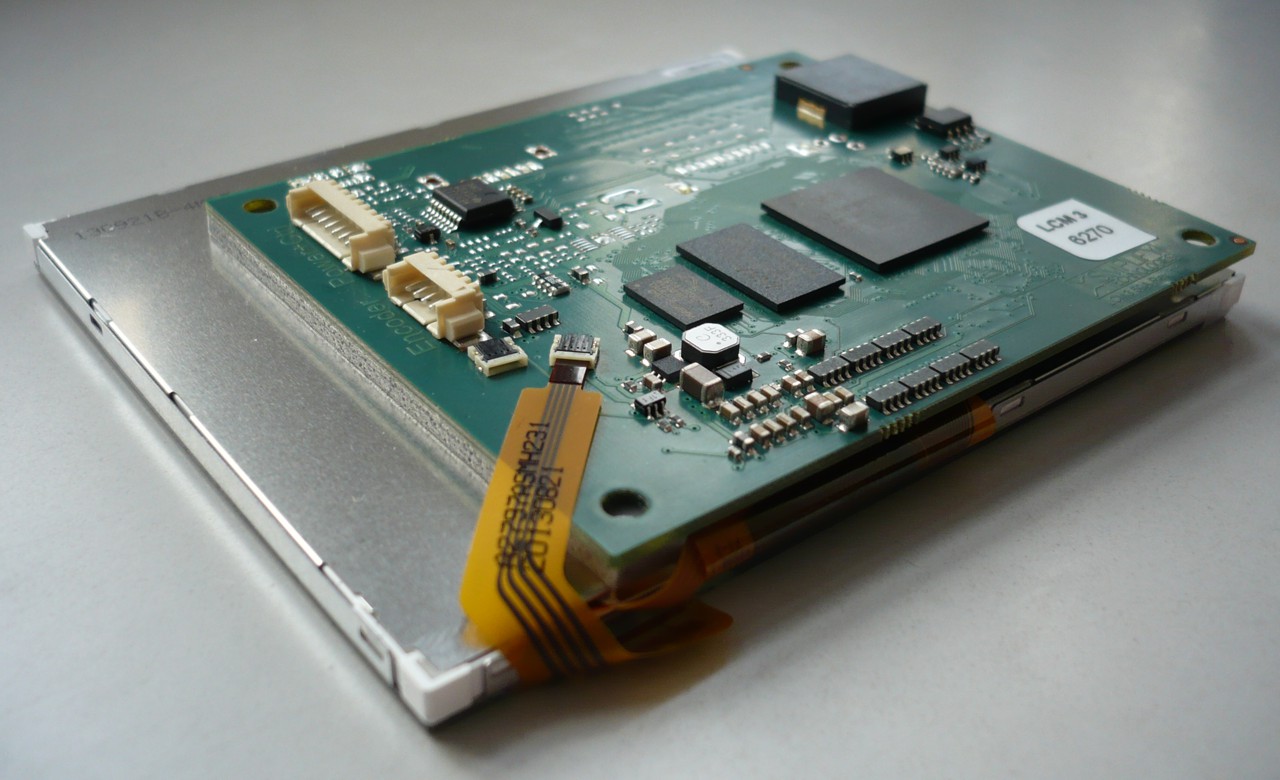
LCM modules are “Smart” because they simplify the task of creating an application’s user interface. The application developers don’t need to generate the actual display signals themselves, but can leave this task to our module. The functionality is already present in the LCM modules so that they can be used directly by an application, thereby significantly reducing the complexity of the user interface development (both hardware and software).
We offer LCM modules as standard products in various sizes, as well as customized developments. Customized models can also be equipped with additional application-specific functions, such as embedded Linux, camera or NFC functionality.